If you look through maintenance schedules or listen to car advice online, you will hear a lot about timing belts and timing chains. Some engines have one, some have the other, and the service needs are very different.
Since a failure in either part can cause big engine damage, it makes sense to know which one your vehicle uses and what that really means for maintenance.
What the Timing System Actually Does
The timing system keeps the crankshaft and camshaft(s) in sync so the valves open and close at the right moment as the pistons move. If that relationship slips, the engine will run poorly, or in some designs, valves and pistons can collide. That is why timing components are treated as critical parts rather than “nice to have” items.
In most modern engines, the timing belt or chain also drives other components, such as a water pump or balance shafts. When those extra parts drag or seize, they can put extra strain on the belt or chain. We always keep that in mind when we inspect, because a weak accessory can shorten timing component life.
How a Timing Belt Works
A timing belt is a reinforced rubber belt with teeth that mesh with sprockets on the crankshaft and camshaft(s). It runs inside a cover, protected from dirt and debris. Over time, heat, age, and oil contamination harden the rubber, crack the surface, and weaken the internal cords.
Most manufacturers give a mileage or time interval for belt replacement, often in the 60,000 to 100,000 mile range, or every certain number of years. When the belt is replaced, it is common to change related parts at the same time, such as tensioners, idler pulleys, and often the water pump. That way you are not paying for the same labor twice if one of those parts fails soon after a new belt is installed.
How a Timing Chain Works
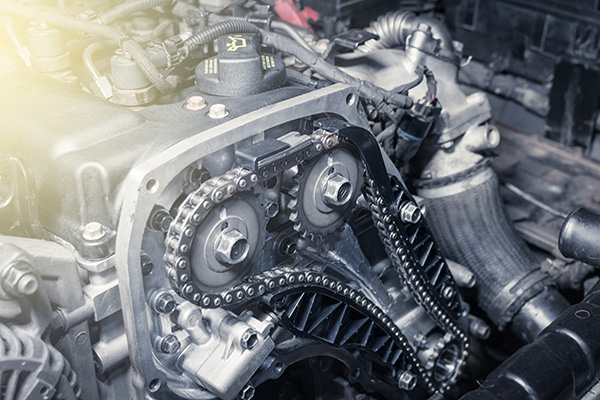
A timing chain is made of metal links, similar to a heavy-duty bicycle or motorcycle chain. It runs inside the engine, lubricated by engine oil, and rides on guides and tensioners that keep it tight and lined up with the sprockets. Chains are generally designed to last longer than belts and are often described as “lifetime” parts, but in the real world, they still wear.
What usually fails first in a chain system is not the chain itself, but the guides and tensioners. Plastic guides can crack or wear down, and hydraulic tensioners can get weak if oil changes are neglected. When that happens, you may start to hear rattling on start-up or notice timing-related trouble codes. At that point, the chain system needs to be inspected, even if the mileage seems low for a “lifetime” setup.
Pros and Cons of Belts vs Chains
Both designs have trade-offs, and neither is completely maintenance free. It helps to think of them this way:
- Timing belts are quieter and often cheaper to build, but they have a clear replacement interval.
- Belts usually cost less in parts, but the service must be done on time to avoid sudden failure.
- Chains can handle more stress and generally last longer, but they depend heavily on clean oil.
- When chains do need replacement, the job is often more complex and more expensive than a belt service.
- Belt failure is usually sudden, while chain problems often show up as noise or codes before things get critical.
Common Symptoms of Timing System Problems
Timing issues can show up in several ways, and the details matter when we track them down. Drivers often report:
- Rattling or clattering noises on cold start that quiet down as the engine warms
- A rough idle, loss of power, or hesitation under acceleration
- Check engine lights with camshaft or crankshaft correlation codes
- Visible cracking, missing teeth, or oil contamination on a timing belt during inspection
- Coolant leaks or noises from the front of the engine when a belt-driven water pump is failing
If you notice any of these signs, it is safer to have the timing system checked before the engine slips far enough out of sync to cause internal damage.
How to Decide Which Services Your Engine Needs
The first step is to confirm whether your vehicle uses a belt or a chain and to check the manufacturer’s recommended service interval. From there, we look at age, mileage, and any symptoms. A timing belt that is past its time or mileage is usually replaced on schedule, even if it looks acceptable, because many belts fail without much visible warning.
For chains, we pay close attention to noise, oil condition, and scan data. A quiet engine with clean oil and no timing-related codes can often keep running without immediate chain work. If there is rattling on start-up, heavy sludge, or clear timing faults in the data, we talk through repair options before a chain problem turns into something much larger.
Get Timing Belt and Timing Chain Service in Marysville, WA, with Bud's Auto Repair & Transmission
We work with both timing belt and timing chain engines every day and know the patterns each design tends to follow. We can check what your engine uses, review its maintenance history, and inspect for early warning signs before they become major repairs.
Call Bud's Auto Repair & Transmission in Marysville, WA, to schedule timing system service and keep your engine running in sync for the long haul.